
Bespoke development is not one decision; it is a stack of them, and each one trades time or flexibility for something the brand values. An original accord buys distinctiveness and costs sampling rounds. Exclusivity buys protection and costs money plus freedom to reformulate. Naturals buy a story and cost consistency. The right position on each trade-off depends on what the travel set is for: a gift that has to feel personal, or a low-risk test of a scent direction.
Key takeaways
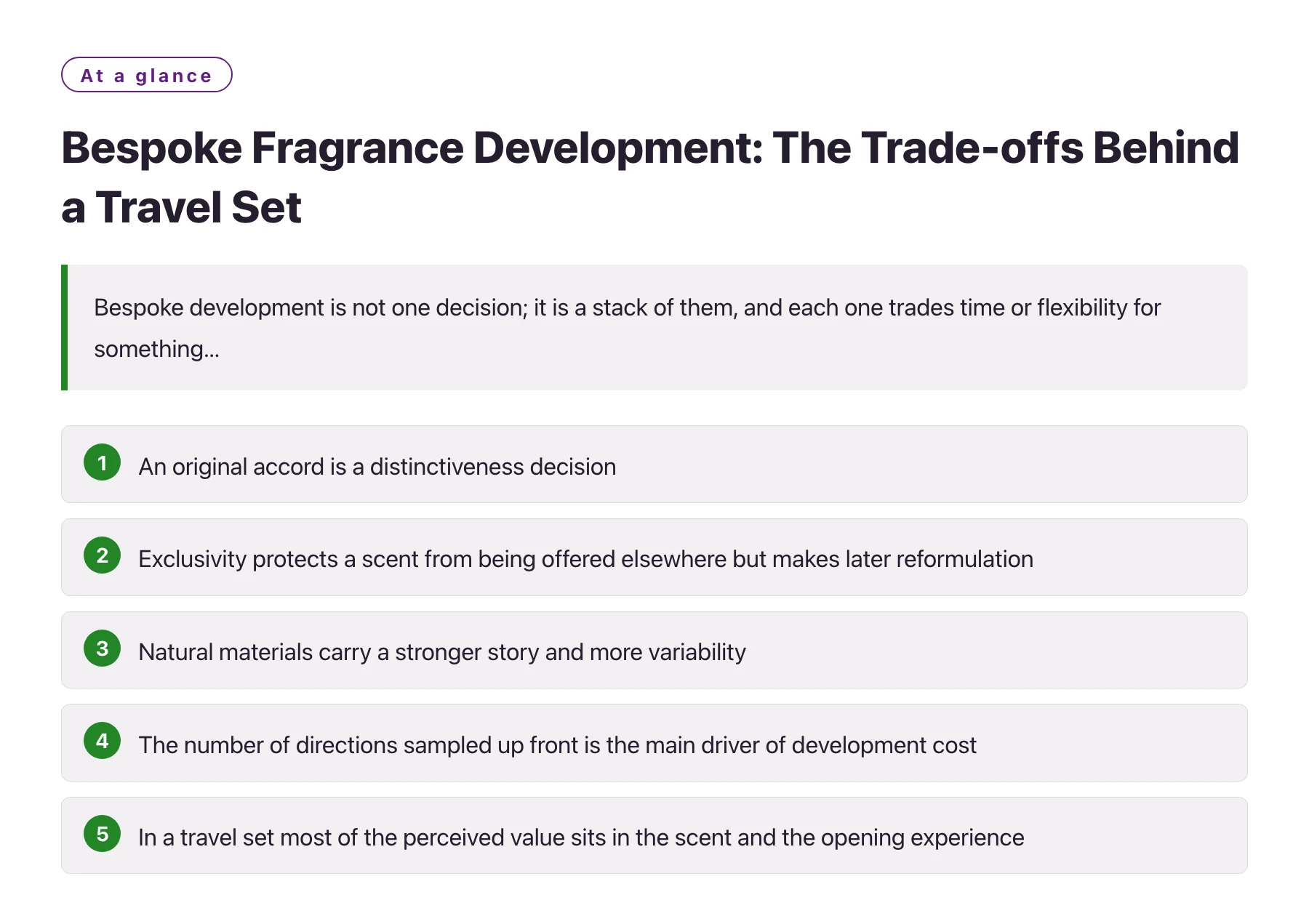
- An original accord is a distinctiveness decision; it buys uniqueness and spends development time, sampling rounds and a testing burden.
- Exclusivity protects a scent from being offered elsewhere but makes later reformulation, if a material becomes restricted, slower and more expensive.
- Natural materials carry a stronger story and more variability; synthetic materials carry consistency and supply predictability, and a good brief uses both.
- The number of directions sampled up front is the main driver of development cost, not the number of revisions after a direction is chosen.
- In a travel set most of the perceived value sits in the scent and the opening experience, not in a custom bottle shape.
Founders often ask what bespoke development costs. The more useful question is what it should include, because the price of a bespoke project is largely the sum of the trade-offs inside it.
This article sets out the trade-offs that actually move a development plan, using the example of a travel or gift set where the scent has to carry a story, and explains how to decide each one deliberately rather than by default.
The six trade-offs in a bespoke brief
| Decision | What you gain | What it costs |
|---|---|---|
| Original accord versus a library scent | A scent that belongs to your brand and can be described as yours | Development time, sampling rounds and a full compliance assessment for the new formula |
| Exclusive versus non-exclusive | Protection from the same accord appearing under another label | A higher price and less freedom to reformulate quickly when a material becomes restricted |
| Natural-led versus synthetic-led composition | A richer provenance story and distinctive character | Batch-to-batch variation and supply that follows harvests rather than a schedule |
| Several directions versus one | A real choice at the start, and a better chance of an obvious winner | More samples, more evaluation time and more cost before a direction is chosen |
| Independent direction versus a reference-driven brief | A scent built for your positioning rather than a comparison | Slower than copying a familiar profile, and safer commercially |
| Scent investment versus custom packaging | Value where the customer actually notices it | A less distinctive shelf silhouette, which matters mainly in physical retail |
Read the table from top to bottom and note which lines you can answer immediately. The unanswered ones are the brief.
The three trade-offs that decide the calendar
Originality against speed
A library accord can be tested in weeks. An original accord starts from an olfactive direction, becomes a formula, is trialled in the final format and then tested. The difference is not a mark-up on creativity; it is the number of loop-backs the project will need. For a set where the scent is the point, the development scope matters more than the pack, and Xuelei custom perfume manufacturing exists for exactly that case.
A practical compromise is to develop one original accord for the set's hero piece and use adjusted library accords for the supporting pieces. The set still reads as yours, and the sampling budget stays finite.
Exclusivity against flexibility
Exclusivity is a contractual position, not a technical property, and it should be agreed before development so that both sides price it honestly [1]. It matters most when a scent is the brand's central asset. It also slows reformulation: when a material is restricted or discontinued, an exclusive formula cannot simply be replaced by a house alternative without renegotiation.
Brands that expect to iterate quickly often take a middle position: exclusive in the brand's product categories, non-exclusive elsewhere, reviewed after two years.
Naturals against consistency
Natural materials vary with origin and harvest, which is part of their appeal and part of their operational cost. Synthetic and nature-identical materials are more consistent and easier to source predictably, which matters for a programme that has to deliver the same set every quarter. Large fragrance houses publish extensively on how materials are selected and blended [2], and most commercial accords are a considered mix rather than a purity test.
Where bespoke tends to be wasted
Three investments are commonly made in the wrong place. A custom bottle mould for a travel set is rarely what a customer remembers; the moment the lid opens is. A long development process aimed at a scent that imitates a well-known profile spends money on the least ownable part of the proposition. And a materials story built on claims the brand cannot evidence creates a compliance liability rather than a marketing asset.
Claims about a cosmetic product are regulated in most markets, and the ingredients behind them are documented in registers such as the EU CosIng database, where functions and restrictions are listed officially [3]. A bespoke brief that names its materials should therefore be checked against the market it will be sold in before the label is written.
The last waste is procedural. Restrictions on fragrance materials apply per material and per product type, and they are published rather than negotiated, so an accord that is fine for one format may not be fine for another [4]. Assess the scent against the format you are actually selling.
Two supporting investments often pay better than a longer sampling programme. Sending the team through a structured course — a place to learn perfumery — improves every brief that follows, because evaluation vocabulary develops faster than taste does. Reading Xuelei's history before a first meeting, meanwhile, tells you how long a supplier has been in this work and which kind of programme it grew up with.
Write your trade-off decisions on one page before briefing: original or library, exclusive or not, naturals or consistency-led, one direction or three. Suppliers can only quote what you have decided.
Sources
- WIPO — World Intellectual Property Organization —— The UN agency for intellectual property; resources on industrial design and patent protection relevant to product and packaging design.
- Givaudan —— One of the largest fragrance and flavour houses; public material on fragrance creation, ingredient portfolio and market segments.
- EU CosIng — Cosmetic Ingredient Database (European Commission) —— The European Commission's CosIng database of cosmetic ingredients, listing ingredient functions, restrictions and labelling requirements under EU cosmetics law.
- IFRA Standards Library (International Fragrance Association) —— The IFRA Standards Library lists the restrictions the fragrance industry applies to individual fragrance ingredients, based on safety assessments; it is the reference point for compliant fragrance formulation.
Frequently asked questions
Is bespoke always better than a library scent?
No. A library accord that fits the brief is faster, cheaper and easier to replace. Bespoke makes sense when the scent is a brand asset, when the positioning depends on it, or when nothing available comes close.
How many directions should I ask to sample?
Two or three is usually enough to compare without overwhelming the evaluation. More directions increase cost and delay without necessarily improving the result.
Does exclusivity stop the factory from making anything similar?
It depends entirely on the wording. Exclusivity should specify the formula, the product categories and the territory it covers, because accord structures are rarely unique in the absolute.
Can a travel set use one accord at different strengths?
Often yes, and it is an efficient way to build a set. The same accord can be presented at different concentrations or in different formats, provided each finished format is assessed for the materials it contains.
What happens if a material in my exclusive scent is later restricted?
The formula has to be adjusted, and an exclusive arrangement can make that slower because the change involves both parties. Ask how reformulation is handled before you sign, not afterwards.